The University of California at Berkeley is a global leader for the study of South Asia, and one of very few institutions in the United States to offer both undergraduate and graduate degree programs focusing on numerous aspects of this vital region. As an integral part of the South Asia curriculum at Berkeley, interest in the study of Pakistan's history, politics, and culture is growing rapidly. We are strongly committed to strengthening our engagement with this subject in the years ahead.
Faculty with a special interest in this region:
Asad Ahmed (Near Eastern Studies), Gregory Max Bruce (South and Southeast Asian Studies), Kiren Chaudhry (Political Science), Lawrence Cohen (Anthropology), Munis Faruqui (South and Southeast Asian Studies), Neil Joeck (Institute of International Studies), Asma Kazmi (Art Practice).
Pakistan-related Visiting Scholars
The Institute regularly accepts visiting scholars who are pursuing a research project on South Asia. In recent years visiting scholars have included Nosheen Ali (2010-2012), Niaz Murtaza (2012 - 2013) and Mona Kanwal Sheikh (Summer 2014).
Pakistan-related Course Offerings
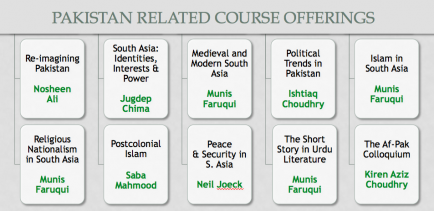 Over the years, UC Berkeley has offered a wide variety of courses that have either focused on Pakistan or have included Pakistan related content. The courses listed below and repeated in the box on the right highlights some of these courses. The course syllabus, as well as the videos used to supplement class discussion, for Nosheen Ali's class titled Re-Imagining Pakistan are available online.
- Re-imagining Pakistan, Nosheen Ali
- South Asia: Identities, Interests & Power, Jugdep Chima
- Medieval and Modern South Asia, Munis Faruqui
- Political Trends in Pakistan, Ishtiaq Choudhry
- Islam in South Asia, Munis Faruqui
- Religious Nationalism in South Asia, Munis Faruqui
- Postcolonial Islam, Saba Mahmood
- Peace & Security in S. Asia, Neil Joeck
- The Short Story in Urdu Liternature, Munis Faruqui
- The Af-Pak Colloquium, Kiren Aziz Choudhry
Pakistan-related Library Collections
The South and Southeast Asia Library (SSEAL) contains a large collection of books in Urdu (24,000), Punjabi (8,000), Sindhi (1050), Pushto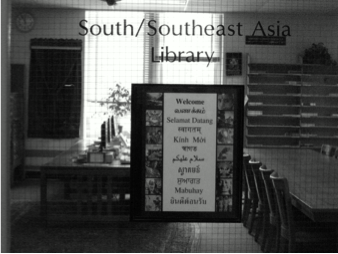 (800), and Kashmiri (700). Most of these books were published in Pakistan. Our Pakistan-focused acquisition efforts have been rapidly increasing over the past years thanks to the interest of Adnan Malik, head librarian for the South Asia collection. A series of faculty-library initiatives have also contributed to additional growth in our already strong Pakistan-specific holdings.
Over the years, the Institute has offered diverse Pakistan-related programming. Some of the more recent events are listed below.
Click the title link to view more information about the event, including video of many events.
Fall 2018
- Raza Rumi | Democracy and its Discontents - Project Naya Pakistan: The Mahomedali Habib Distinguished Lecture for 2018
- Sandow Birk: American Qur'an
- Salam - The First ** Nobel Laureate (Screening)
Spring 2018
- William E. B. Sherman | A Practice of Revelation: Apocalypse, Vernacular, and Identity along the Afghan Frontier (Lecture by the S.S. Pirzada Dissertation Prize in Pakistan Studies Winner for 2018)
- Arthur Dudney | Testing the Limits of Comparatism: The Quarrel of the Ancients and Moderns in Persian and Urdu Literary Culture
- Gregory Maxwell Bruce | Travels through Four Languages: Shibli's Great Journey
- Teena Purohit | The “Protestant” Impulse in Modern Islamic Thought
Fall 2017
- David Gilmartin | Pakistan's Creation and the Contested Grand Narratives of 20th Century History
- Samira Sheikh | Aurangzeb: A Gujarati Badshah?
- Ejaz Hussain | Neither Transition nor Transformation: Hybridization of Civil-Military Relations in Contemporary Pakistan
Spring 2017
- Eye on South Asia: Challenges to Development and Democracy in Afghanistan, Bangladesh, India, Pakistan, Sri Lanka, and Nepal
- Kirti Jain | Performing Partition: On Producing "Aur Kitne Tukde" (How Many Fragments?)
- Ayesha Siddiqa | Pakistan: Civil-Military Relations in a Changing Domestic, Regional and Global Environment
- Katherine Schofield | The Place of Pleasure: Music in Mughal Thought and Society, 1593–1707
Fall 2016
- Jonathan Mark Kenoyer | The Indus Civilization - Changing Perspectives on Regional Origins, Diverse Character and Complex Legacy
- Ali Eteraz | Native Believer: A Novel
Spring 2016
- The Domestic Crusaders: A Dramatic Comedy in English by Wajahat Ali
- Significance of Pakistan-US relations towards security and stability in South Asia: Ambassador of Pakistan to the United States
- Timurid Sovereignty in pre-Mughal India
- Into that Heaven of Freedom: The impact of Apartheid on an Indian Family’s Diasporic History
- The West is a Career: Pakistan's Shi'i Islam between the local and the transnational
- Adab as Mobility, between early modern Iran and India
- Making Indian Migrants - National Branding and Localized Disruptions in the Migration of Workers to the Persian Gulf
- The Potential and Challenges of Customer Feedback in the Public Sector: Zubair Bhatti makes a case for Pakistan
Fall 2015
- The Pakistan Paradox: The 3rd Mahomedali Habib Distinguished Lecture by Christophe Jaffrelot
- Manto, A film by Sarmad Sultan Khoosat: A screening with Director present
- Political Poetry in Contemporary Pakistan: An Evening with Pakistani Poet and Nonfiction Writer Harris Khalique
- Learning from Lahore: A talk by Will Glover on the urban history of the city and the country across the long twentieth century
Spring 2015
- Housetalk and the Limits of Conversion: South Asian Domestic Workers' New Found Islamic Pieties in the Greater Arabian Peninsula
- The S.S. Pirzada Dissertation Prize in Pakistan Studies Award Ceremony: Lecture by the 2015 Award Winner, Dr. Amber H. Abbas
- Pakistan: Beyond the Security State
- Orphanhood and the Art of Not Being Cared For
- [Report] Fixing Pakistan's Education: Innovative Solutions for a major Challenge
- Munis Faruqui - Welcome
- Salman Humayun - Synergizing Technical and Political Interface for Education Reforms
- Shashi Buluswar - Technological Innovations for Education Reform in Pakistan Part 1
- Bilal Musharraf - Technology Interventions in a Developing Education Ecosystem
- Ameen Jan - Implementing Technology Solutions in Education
- Sanaa Riaz - Technology and Second Language Learning in Pakistani Public Schools
- Shashi Buluswar - Technological Innovations for Education Reform in Pakistan Part II
- Adil Ajmal - Panel Discussion "Technological Solutions"
- Amjad Noorani - The Role of NGOs and Donors in Education Reform
- Umair Khan - Panel Discussion "Social & Policy Challenges & Opportunities"
Fall 2014
- Urdu Cinema During the 1950s
- Religion, State and Society in Pakistan - Searching for Identity in an ex-Colonial State and Elite Circulation: The 2nd Mahomedali Habib Distinguished Lecture by Ayesha Siddiqa
- The Scatter here is too Great: Book talk by author, Bilal Tanweer
- How to (Really) Fix Pakistan's Education System: A Talk by LUMS Dean, Anjum Altaf
Spring 2014
- Talking with the Pakistani Taliban
- The Warrior State: Pakistan in the Contemporary World
- Fiction and How to Get Filthy Rich in Rising Asia: In conversation with Mohsin Hamid
- Kala Pul (The Black Bridge)
- Mangoes, Alice, and the Missing Baloch: In conversation with Mohammed Hanif
Fall 2013
- Democratic Transitions in Pakistan and its Impact on Human Rights
- No Exit from Pakistan: America's Tortured Relationship with Islamabad
Spring 2013
- Higher Education in Pakistan: Designing a Liberal Core for Post-Colonial Pakistan
- Muslim Zion: Pakistan as a Political Idea
- Fierce Courage: Muslim Women's Transformative Activism
Fall 2012
- Under the Drones: Modern Lives in the Afghanistan-Pakistan Borderlands
- 'The Evidence of Things Not Seen'?: An Artist's Explorations of Afghanistan's 21st Century Reconstructions and 20th Century Histories.
- Afghans Look at 2014
- Constructing “Home” in Transnational Spaces: The Case of Japanese-Pakistani Muslim Families
- Partition of India: Debates in History and Literature
Spring 2012
- Environmental History and the Creation of Pakistan
- Sources of Tension: Pakistan, Its Neighbors and Regional Security
- Why foreign aid does not work in countries like Pakistan
- Why Pakistan Matters
- Musings on Pakistan
- Changing perspectives on the Indus Civilization: New insights from excavations in Pakistan and India
Fall 2011
- What Went Wrong?: Tracing the Troubled Trajectory of Development, Governance and Security in Pakistan, 1947-2011
- Playing with Fire: Pakistan at War with Itself
- Guftugu: Celebrating Faiz Ahmed Faiz
- Guftugu: Contemporary Pakistani Art
- Pakistan and the US - Challenges and Opportunities
- Poetry, Power, Protest: Re-imagining Muslim Nationhood in Northern Pakistan
Spring 2011
- The Redefined Dimensions of Baloch Nationalist Movement
Fall 2010
- Breaking the Silence: Women in Afghanistan and Pakistan
- Afghanistan - A Unit of Analysis: Round Table Discussion
- The Pakistan Flood Crisis: An Alternate Perspective
- Islam, Youth and New Media
Spring 2010 and earlier
- Hamid Mir -- The Resurgence of al Qaeda and the Taliban in Pakistan" | Media
- Abid Hasan Minto -- The Pakistani Crisis: On the current situation in the sub-continent and India-Pakistan Relations
- Ahmad Salim -- Preservation and Promotion of Archives in Pakistan | Media
- Huma Yusuf -- The War Against Terror : Five Reasons for the Persistence of Anti-Americanism in Pakistan
- Alice Albinia -- Empires of the Indus: The Story of a River
On October 8, 2013, ISAS officially launched a Pakistan@Berkeley Initiative
Its long-term goals include hiring faculty who specifically work on Pakistan, broadening and deepening understanding of Pakistan by sponsoring talks and conferences on campus and across the Bay Area, promoting scholarly exchanges between UC Berkeley and educational institutions in Pakistan, raising funds for graduate fellowships (to train the next generation of scholars of Pakistan), and providing funding for Pakistan-specific courses at UC Berkeley.
Read more about this launch in the 2013 issue of Khabar, our annual newsletter. (pages 4 and 5)
We look forward to working with supportive individuals and organizations to accomplish these goals. For further information, please contact:
Sanchita Saxena, Executive Director
Institute for South Asia Studies
(510) 642-3608
sanchitas@berkeley.edu
Munis Faruqui, Professor
Dept. of South & Southeast Asian Studies
(510) 643-9188
faruqui@berkeley.edu